Not just a forecast tool, not a standalone warehouse module, and not isolated budgeting. UBC Analytics Distribution links demand, inventory, purchasing, margin, working capital, and cash flow into one decision model.
You are not buying a single module — you are buying control over distributor economics
The market has systems for forecasting, inventory, or WMS. UBC Analytics Distribution operates at a higher level: it unifies functions into one management logic where every decision is immediately visible in revenue, margin, inventory, and liquidity.
Not just forecasting
A forecast alone does not solve the business problem. What matters is how it impacts Fill Rate, shortages, revenue, inventory, and purchasing.
Not just warehouse or WMS
A warehouse system knows where the goods are. UBC shows how much stock to hold, how much cash it locks, and how it impacts DIO and CCC.
Not just budgeting or P&L
A financial plan without operational logic drifts away from reality. UBC converts demand and inventory into profit, working capital, and real cash movement.
MEASURABLE RESULTS
What changes after implementation
According to research by Gartner and Oliver Wight, moving from Excel and isolated tools to a unified management system delivers a proven financial impact for distribution.
+12–18%
Revenue growth
Better forecasting, shortage control, and aligned purchasing reduce lost sales and increase service levels.
Before: 100%After: 100%
+3–7 п.п.
Gross margin improvement
Transparent price waterfall, rebates, trade spend, and cost-to-serve show which SKUs, clients, and channels truly generate profit.
Before: 28%After: 28%
−20–30%
Less cash in inventory
Managing safety stock, coverage, reorder points, and purchasing frees working capital without hurting service levels.
Before: ₴12MAfter: ₴12.0M
CCC −15
days
Managed cash flow
Payment calendars, liquidity gap analysis, and scenarios enable proactive cash management rather than after-the-fact reaction.
Before: 54 daysAfter: 54days
TRANSPARENT PROFITABILITY
Know what generates profit and what only creates turnover
No need to wait until month-end to understand the result. UBC Analytics Distribution provides managerial P&L by SKU, client, channel, region, and brand — including logistics, trade spend, and indirect costs.
✓Profitability by SKU, client, channel, brand, and region
✓Break-even analysis by products, clients, and channels
✓Weekly rollforward and variance driver analysis
✓Budget / Forecast / LE / Actual comparison in one view
360°
visibility
across all dimensions
LIVE P&L
+18.4%
Gross Margin vs. plan
ONE DECISION FLOW — FROM DEMAND TO CASH
Not a set of modules — one management logic
Each decision automatically impacts the next contour: forecast shapes inventory, inventory shapes purchasing, purchasing and pricing shape margin, and the whole model drives cash flow and working capital.
Dedicated dashboards for CEO, commercial teams, supply chain, finance, and treasury — all built on one data model.
UBC Analytics Distribution Management Contours
A detailed description of each of the 9 functional system blocks covering all key processes: from demand forecasting to liquidity management.
Demand & Sales Planning
Forecasting not as an end in itself, but as the starting point for the entire decision chain.
CONTOUR TASK
Determine what, to whom, through which channel, in what volume, and with what frequency the company plans to sell. The contour builds a forecast using statistical models, seasonality, trends, promotions, SKU substitution, customer behavior, and management overrides.
BUSINESS VALUE
A quality forecast matters not by itself, but because it defines shortages, purchasing plans, inventory levels, service levels, and future revenue. It is the entry point into the distributor’s entire economics.
ABC/XYZForecastScenariosChannels / Clients
Inventory Planning
Not just stock control, but management of cash invested in inventory.
CONTOUR TASK
Calculate safety stock, reorder points, target stock, coverage weeks, maximum inventory levels, and inter-warehouse transfer plans. Demand variability, lead time, seasonality, promotions, and service level parameters are all taken into account.
BUSINESS VALUE
Inventory is not only an operational metric, but frozen working capital. This contour helps reduce overstock, avoid shortages, and keep DIO and the cash conversion cycle under control.
Safety StockDIOReorder PointCoverage
Purchasing Planning
Synchronizing demand, inventory, delivery schedules, and supplier payments.
CONTOUR TASK
Automatically generate a calendar plan for supplier orders based on forecast, current inventory, and replenishment parameters. The contour considers lead time, MOQ, packaging multiples, shipment schedules, and purchasing budget constraints.
BUSINESS VALUE
Purchasing stops being reactive. The company sees in advance when and how much to order, and how this will impact inventory, supplier payments, DPO, and future cash flow.
Lead TimeMOQDelivery SchedulePayment Plan
Logistics Planning
From transport and warehousing to real cost-to-serve by client and channel.
CONTOUR TASK
Plan transport volumes, vehicle requirements, warehouse handling, customs costs, and other logistics items. Then allocate these costs to SKUs, clients, channels, or regions for full profitability analysis.
BUSINESS VALUE
In distribution, delivery often eats up all margin. The cost-to-serve contour reveals where the company truly makes money and where revenue only looks good before logistics costs are considered.
Cost-to-ServeTransportWarehouseCustoms
Revenue & Gross Margin
Turning a volume sales plan into financial performance.
CONTOUR TASK
Add pricing conditions, front margin, back margin, rebates, marketing funds, and other commercial mechanics to the forecast. Build Net Sales, Gross Margin, and the pricing waterfall by SKU, client, channel, and brand.
BUSINESS VALUE
The company stops looking only at revenue. It sees how discounts, bonuses, customer terms, and pricing exceptions impact real gross margin and, ultimately, EBITDA.
Net SalesGross MarginRebatesPricing Waterfall
Commercial & Marketing Expenses
Control of trade spend, sales incentives, and marketing ROI.
CONTOUR TASK
Plan budgets for trade marketing, listing fees, e-commerce, sales team incentives, promo activities, and brand support. Link these expenses to categories, clients, channels, and sales targets.
BUSINESS VALUE
This contour shows not only the amount of commercial spending, but its return. It protects the company from burning budget without impact on revenue, margin, or sales share.
ROITrade SpendSales IncentivesPromo
G&A Expenses
Control of fixed costs and business resilience under different scenarios.
CONTOUR TASK
Plan back-office OPEX, IT, rent, administrative payroll, taxes, depreciation, and CAPEX. Build a unified departmental budget and cost scenarios for different sales levels.
BUSINESS VALUE
The company sees where the safe fixed-cost baseline lies and can quickly assess the impact of seasonality, sales declines, or channel mix changes on operating profitability.
CAPEXOPEXPayrollDepreciation
Profitability, Allocation & P&L
One managerial financial result across all business dimensions.
CONTOUR TASK
Consolidate all revenues and expenses into one managerial P&L and allocate indirect costs to branches, channels, clients, brands, and SKUs using drivers such as revenue, volume, deliveries, area, or transaction counts.
BUSINESS VALUE
It reveals hidden unprofitability. The company sees not only whether it is profitable overall, but exactly who earns money and who consumes margin after logistics, commercial, and administrative burdens are allocated.
EBITDAAllocationDriversFull P&L
Cash Flow & Working Capital
Turning the operating plan into controlled liquidity.
CONTOUR TASK
Transform the sales plan and P&L into Cash Flow. Consider DSO, DPO, DIO, payment schedules, credit limits, taxes, purchasing, and other cash events. Build a payment calendar, liquidity gap scenarios, and a CCC forecast.
BUSINESS VALUE
Profit is not cash. A company may be profitable on paper and still face a cash gap. This contour translates planning into the language of actual solvency and financial resilience.
CCCDSO / DIO / DPOCash GapsFCF
TECHNOLOGICAL CORE
Built on the power of IBM Planning Analytics
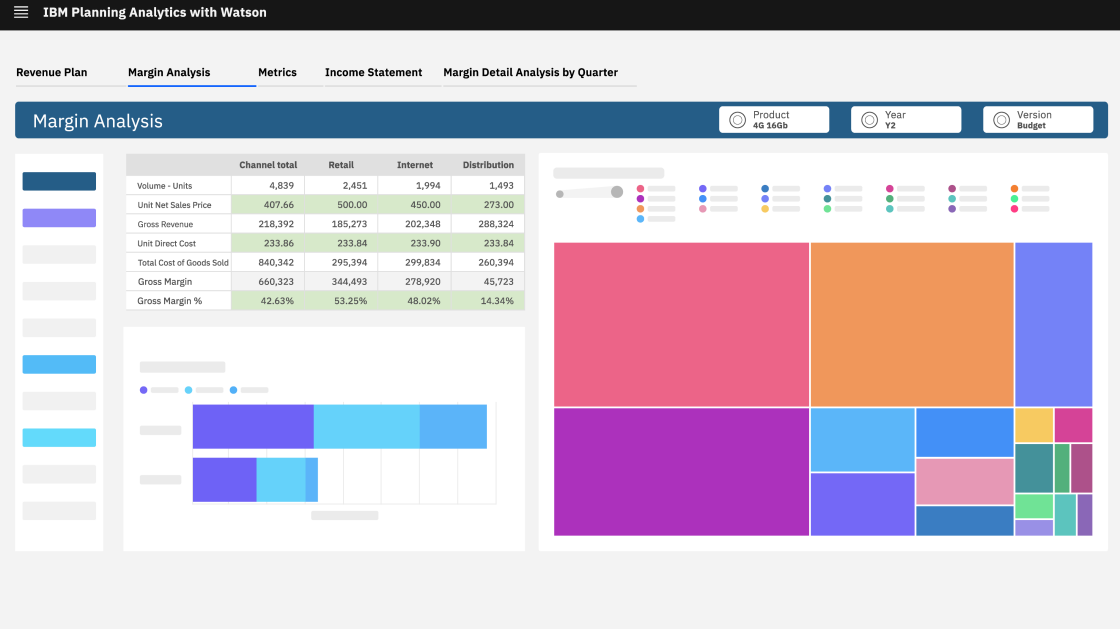
UBC Analytics uses the IBM TM1 enterprise engine. This means instant recalculation of terabytes of data, no freezing (like in Excel), and a single source of truth for the entire company.
In-Memory OLAP
Calculations happen in RAM. Changing the price of a single SKU instantly recalculates the entire company's P&L and Cash Flow.
AI & Analytics
Built-in IBM forecasting and machine learning algorithms for accurate predictive demand analysis.
Familiar Excel Interface
Full integration with MS Excel. Finance teams continue working in their familiar environment, but with a centralized database.
Enterprise Security
Cell-level access security. You decide who sees the margins and who only sees sales volumes.
Leading companies trust IBM Planning Analytics
THREE MANAGEMENT LEVELS
The system works at every level
The CEO sees business economics, the CFO sees cash flow and working capital, the commercial team sees revenue and margin, supply chain sees inventory and purchasing, and managers see weekly actions.
MANAGEMENT PYRAMID
Strategic
12-18 mo
Tactical
1-3 months
Operational
1-4 weeks
Strategic
HORIZON: 12-18 MONTHS
CEO, CFO, COMMERCIAL DIRECTOR
Annual budget and growth scenarios
SKU portfolio and channel strategy
Margin and working capital targets
EBITDA and cash flow scenario modeling
+22%
EBITDA
Tactical
HORIZON: 1-3 MONTHS
SUPPLY CHAIN, FP&A, LOGISTICS, COMMERCIAL
Monthly forecast and replanning
Supply and ordering plan
Inventory and service management
Variance analysis in margin and cash
97.2%
Fill Rate
Operational
HORIZON: 1-4 WEEKS
PURCHASING, WAREHOUSE, TREASURY, FINANCE CONTROL
Weekly rollforward
Payment calendar
Inventory replenishment
Control of shortages and cash gaps
0
GAP
Integration with your ecosystem
UBC Analytics Distribution does not replace ERP, WMS, CRM, or TMS — it unifies their data into one management flow. Transactions stay in the source systems, while decisions are made at the UBC level.
ERP
WMS
CRM
TMS
1C
SAP
EXCEL
ABOUT COMPANY
We do not sell a constructor — we implement a ready management model for distributors
UBC Analytics helps companies move from fragmented Excel files and isolated modules to a unified system for managing revenue, inventory, profitability, and liquidity on the IBM Analytics platform.
IBM
Partner expertise
Deep implementation practice on IBM Analytics with enterprise-level support.
> 100
Projects
Implemented IBM Analytics projects across industries and countries.
> 18
Years of experience
Proven experience building budgeting, treasury, profitability, and integrated planning solutions.
> 30
Countries
International experience in project delivery and management analytics.
Expert analysis of your business tasks
Get a free analysis of your processes. We will discuss your current challenges and demonstrate the benefits of UBC Analytics and IBM Planning Analytics.
Thank you! We will get back to you shortly.
LET'S START TOGETHER
Request a demo based on your business scenario
We will show not just the interface, but how to connect sales, inventory, purchasing, margin, and cash flow in one management model for your company.
✓Free demo using a distribution use case
✓Quick analysis of money leakage points: stock, margin, cash